Bali wet season guide
Bali in the wet season: is it worth it? (Nov-Mar honest guide)
The wet season runs November to March, and most guides either dismiss it or pretend the rain does not exist. Both are wrong. The rain is real: January averages 345 mm over 27 rain days. But it comes in short heavy afternoon showers, mornings are often clear, hotel rates drop 25 to 40 percent, and the terraces are at their greenest. This page answers the five myths people actually believe, with the data behind each one.
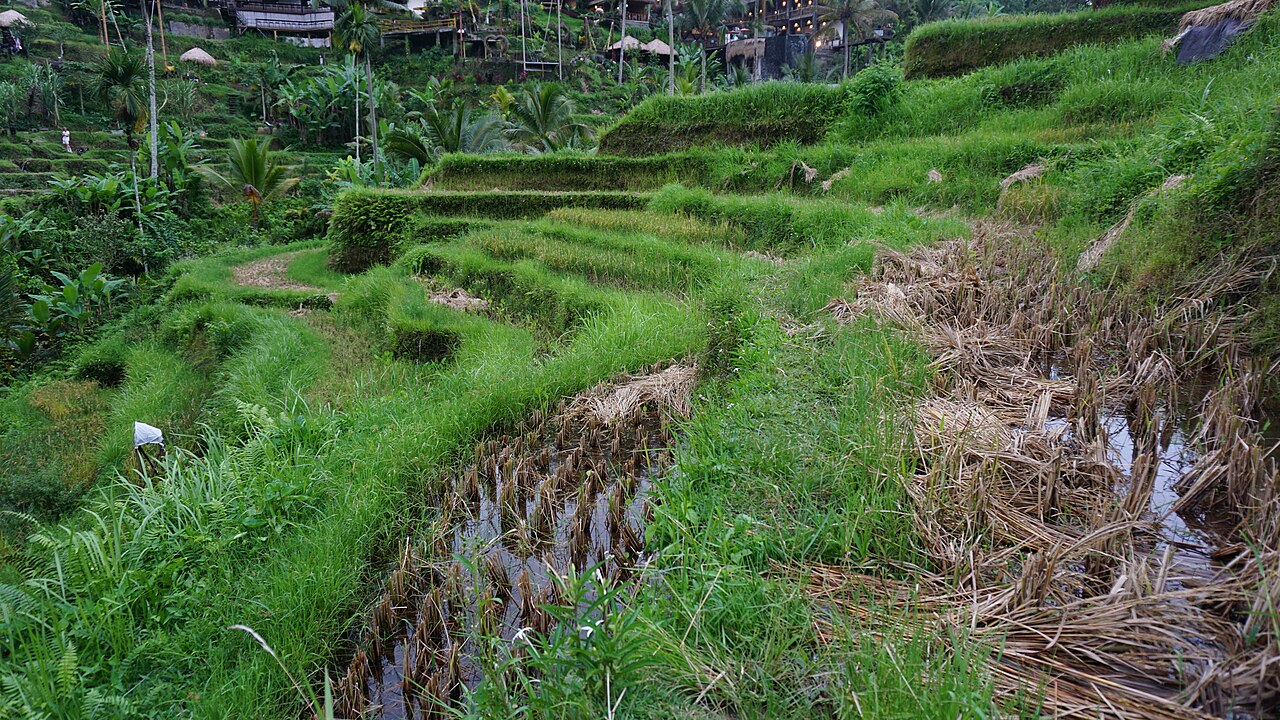
Myth 1: "It rains all day"
No. January has 27 rain days on the BMKG long-term record, which means rain falls on most days, but the pattern is what matters: the rain usually comes in short heavy afternoon showers, and mornings are often clear. A typical wet-season day is a dry, warm morning, a hard downpour in the afternoon, and a clear evening. The rainfall totals look dramatic, 345 mm in January, 274 mm in February, 234 mm in March, because tropical rain falls fast and hard, not because it falls all day. Plan around the pattern, not the totals: do the outdoor things before lunch, and keep afternoons for spas, cafes, and the pool.
Myth 2: "You cannot do anything"
Most of what people come to Bali for works fine in the wet season. Temples, rice terraces, markets, cooking classes, and jungle walks are all morning activities, and mornings are the driest part of the day. The terraces are at their greenest and fullest, and the waterfalls run strongest. Surfing does not stop either: it moves coast. From November to March the clean surf shifts to the east coast, with Keramas, Sanur, and Nusa Dua turning on while the west coast sits onshore (2026 surf guides, TravJoy and SurfVagabond). The one thing to skip is a scooter ride in a downpour: wet roads and low visibility are a bad combination, and a Grab car costs $1 to $3 for a short ride.
Myth 3: "The beaches are ruined"
Not ruined, but different. The west coast, Kuta, Canggu, and the Bukit, gets onshore wind in the wet season, and heavy rain washes debris down the rivers onto the sand. The east coast, Sanur and Nusa Dua, is the cleaner side from November to March, with offshore winds and calmer water. If beach time is the point of your trip, base yourself on the east coast in the wet season, or accept that west-coast beach days are morning affairs. The beaches are still there, still warm, and far less crowded: February drew 450,697 foreign arrivals in 2025, against 697,107 in July (BPS Bali).
Myth 4: "It is not worth the flight"
The wet season is the best-value season in Bali. Low-season rates run 25 to 40 percent below the annual average (VoyageHacks, 2026), and the cheapest weeks of the year fall in late January and February (see the cheapest month guide). You get the island at its quietest, its greenest, and its cheapest, with the same warm temperatures: average highs run 33.0 C to 33.6 C from January to March. The flight costs the same either way. What changes is what the same money buys once you land.
Myth 5: "Everything is closed"
No. Bali has no winter shutdown: hotels, restaurants, beach clubs, temples, and attractions operate year-round, and the wet season is a normal operating season, not a closure. The one exception is Nyepi, Bali's Day of Silence, which closes the island for 24 hours, with no flights and no traffic. Check whether your dates overlap Nyepi before you book, and otherwise expect everything to be open, with shorter queues and easier bookings than in July.
What a wet-season day actually looks like
Morning: clear, warm, and humid. This is when you do the terrace walk, the temple visit, the surf session, or the market. Midday: cloud builds. Early afternoon: the downpour, usually heavy and short, sometimes with thunder. Late afternoon: the rain eases, the light turns gold, and the evening is often clear. Dinner outside is normal. The pattern is not a guarantee, some days stay grey, and January can deliver a genuinely wet stretch, but the afternoon-burst pattern is the norm, not the exception.
What the wet-season discount looks like
The 25 to 40 percent low-season cut applies across the board, and it stacks with Bali's already-low budget range. VoyageHacks 2026 budget ranges, before the low-season cut, run: homestays $15 to $25 a night, guesthouses $25 to $50. By area: Ubud $18 to $35, Sanur $20 to $40, Seminyak $25 to $50, Canggu $25 to $45, Kuta $15 to $30. We do not publish per-area discount figures, because no source breaks the cut down by area: treat the 25 to 40 percent range as the guide, and confirm the actual rate at booking. See the budget guide and the price index for what each tier buys.
Practical tips for the wet season
Book free cancellation. Low-season rates are cheap because demand is soft, and a free-cancellation rate lets you rebook if a better price appears. In the wet season this matters more, not less: you may want to move a base if a storm settles in.
Pack for the pattern. A light rain jacket or a cheap poncho, a dry bag or a zip-lock for your phone, and sandals you do not mind getting soaked. Leave the umbrella at home: tropical rain comes sideways.
Do not ride a scooter in the rain. Wet roads, low visibility, and Bali traffic are a bad mix. Take a Grab car instead, and remember the licence rule still applies: you need an International Driving Permit with a motorcycle endorsement to ride legally, with a fine of about IDR 1,000,000 without it (see getting around Bali).
Keep mornings for the outdoors. Temples, terraces, and waterfalls before lunch. Afternoons for the spa, a cooking class, or a long lunch. Evenings are usually clear enough for dinner outside.
Check the total price. Bali hotels add about 11 to 21 percent service and tax at checkout, and the IDR 150,000 tourist levy applies per person per trip. A discounted rate is still a discount, but confirm the final price before you pay.
Plan the rest of the trip with the best time to visit guide, the when to book page, and the crowd index.
Frequently asked questions
Is Bali worth visiting in the wet season?
Yes: rain comes in afternoon bursts, mornings are often clear, hotel rates drop 25 to 40 percent, and the terraces are at their greenest. The wet season runs November to March, with January the wettest month at 345mm of rain.
Does it rain all day in Bali in the wet season?
No, wet-season rain comes in afternoon bursts, with mornings often clear. January averages 27 rain days, but most days have dry mornings. Plan outdoor activities before lunch and indoor activities for the afternoon.
Can you surf in Bali in the wet season?
Yes, clean surf moves to the east coast in the wet season: Keramas, Sanur, and Nusa Dua. The west coast breaks get onshore winds from November to March.
Sources: BMKG rainfall and rain days via WMO, 1961-1990; BPS Bali foreign arrivals 2025; VoyageHacks 2026 budget ranges and low-season discount range; 2026 surf guides (TravJoy, SurfVagabond) for wet-season surf coasts; this site's getting-around guide for transport costs and the licence rule. Checked November 14, 2026.